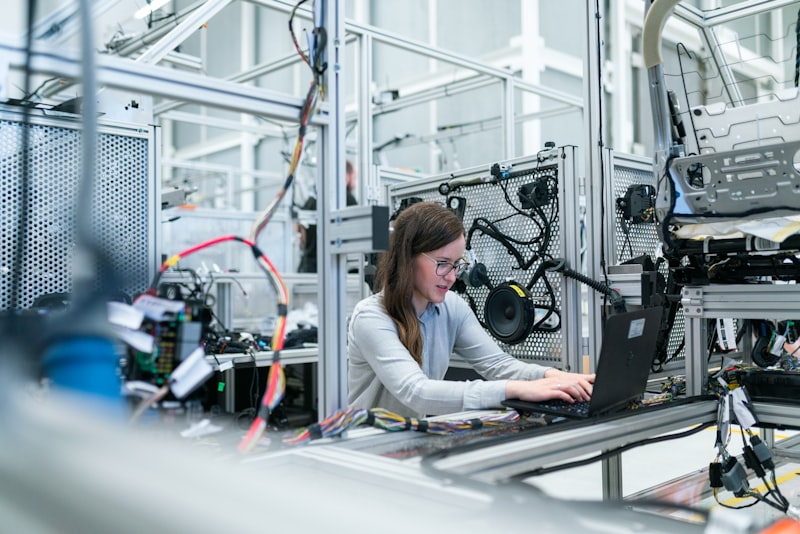
The Industrial IoT Revolution: A New Era of Manufacturing
The Industrial Internet of Things (IIoT) is fundamentally transforming how manufacturers, energy companies, logistics providers, and industrial operations function in the modern era. By connecting machines, sensors, and systems through advanced networks, IIoT is enabling unprecedented levels of operational efficiency, predictive maintenance, and data-driven decision-making.
This comprehensive guide explores how the Industrial IoT Revolution is reshaping industries, the technologies driving this transformation, and what businesses need to know to stay competitive in 2025 and beyond.
What is Industrial IoT (IIoT)?
Industrial IoT refers to the interconnected network of sensors, instruments, devices, and machinery used in industrial settings. Unlike consumer IoT devices, IIoT systems are designed for:
- High reliability and uptime requirements - Industrial operations cannot afford frequent failures
- Real-time data processing - Critical decisions require immediate information
- Extreme environment operation - Sensors must work in harsh conditions
- Enterprise-scale integration - Connecting thousands of devices across facilities
Key Technologies Driving the IIoT Revolution
1. Advanced Sensor Technology
Modern industrial sensors can monitor temperature, pressure, vibration, humidity, chemical composition, and countless other parameters with unprecedented accuracy. These smart sensors now include built-in processing capabilities, enabling edge computing and reducing latency.
2. Edge Computing
Processing data closer to its source reduces bandwidth requirements and enables real-time decision-making. Edge computing is crucial for applications requiring immediate responses, such as safety systems and quality control.
3. 5G and Advanced Connectivity
5G networks provide the low-latency, high-bandwidth connectivity needed for massive IIoT deployments. This enables wireless sensor networks that were previously impractical.
4. Artificial Intelligence and Machine Learning
AI algorithms analyze vast amounts of sensor data to predict equipment failures, optimize production schedules, and identify efficiency improvements that humans might miss.
5. Digital Twins
Virtual replicas of physical assets allow engineers to simulate scenarios, test changes, and optimize operations without disrupting actual production.
6. Cloud Computing and Big Data Analytics
Cloud platforms provide the computational power and storage needed to process and analyze massive datasets from industrial operations.
Transformative Applications of Industrial IoT
Predictive Maintenance
Instead of following fixed maintenance schedules or waiting for equipment to fail, IIoT enables predictive maintenance. Sensors monitor equipment health in real-time, detecting early warning signs of potential failures. This approach:
- Reduces unplanned downtime by 50-70%
- Extends equipment lifespan by 20-40%
- Cuts maintenance costs by 25-30%
- Improves worker safety by preventing catastrophic failures
Smart Manufacturing and Industry 4.0
IIoT is the backbone of Industry 4.0, enabling smart factories where:
- Production lines automatically adjust to demand changes
- Quality control systems detect defects in real-time
- Inventory management becomes autonomous and optimized
- Energy consumption is continuously optimized
- Custom products can be manufactured at mass production speeds
Supply Chain Optimization
Real-time tracking of materials, products, and shipments provides unprecedented supply chain visibility. Companies can:
- Track shipments globally with precise location and condition data
- Optimize routes based on real-time traffic and weather
- Monitor product quality during transportation
- Automate warehouse operations with smart robotics
Energy Management and Sustainability
IIoT sensors monitor and optimize energy consumption across facilities:
- Identify energy waste and inefficiencies
- Balance renewable energy sources with grid power
- Reduce carbon footprint through optimization
- Meet regulatory compliance requirements
Worker Safety and Monitoring
Wearable IoT devices and environmental sensors protect workers by:
- Detecting hazardous gas leaks or dangerous conditions
- Monitoring worker health vitals in real-time
- Alerting workers to nearby heavy equipment
- Ensuring compliance with safety protocols
Real-World Success Stories
Manufacturing: Siemens Amberg Factory
Siemens' electronics plant in Amberg, Germany, uses over 1,000 connected sensors and produces one controller per second with a defect rate of just 0.0012%. IIoT implementation increased productivity by 8x while maintaining the same physical footprint.
Oil & Gas: BP's Digital Twin Initiative
BP created digital twins of offshore platforms, using IIoT sensors to monitor equipment health. This reduced maintenance costs by $500 million annually and improved safety by predicting potential failures before they occur.
Logistics: DHL Smart Warehouses
DHL's smart warehouses use IIoT-enabled robots and sensors to optimize operations, reducing order processing time by 40% and improving inventory accuracy to 99.9%.
Challenges and Considerations
Cybersecurity
Connected industrial systems create new attack surfaces. Organizations must implement robust security measures including:
- Network segmentation and isolation
- Encrypted communications
- Regular security audits and updates
- Employee training on security best practices
Data Management
IIoT deployments generate massive amounts of data. Companies need strategies for:
- Data storage and retention
- Real-time processing vs. batch analytics
- Data quality and validation
- Compliance with data privacy regulations
Integration with Legacy Systems
Many industrial facilities operate equipment that's decades old. Successful IIoT implementation requires careful integration strategies that don't disrupt existing operations.
Skills Gap
The IIoT revolution requires workers with expertise in both industrial operations and digital technologies. Companies must invest in training and development programs.
The Future of Industrial IoT
2025-2030 Predictions
- Autonomous Industrial Operations: Fully self-optimizing factories with minimal human intervention
- 6G Networks: Even faster, more reliable connectivity enabling new applications
- Quantum Computing Integration: Solving complex optimization problems in real-time
- Advanced AR/VR: Technicians using augmented reality for maintenance and training
- Sustainable Manufacturing: IIoT driving zero-waste, carbon-neutral operations
Emerging Technologies
Several technologies will accelerate IIoT adoption:
- Blockchain: Ensuring supply chain transparency and authenticity
- Advanced Materials: Self-healing sensors and components
- Neuromorphic Computing: Brain-inspired processors for edge AI
- Satellite IoT: Connectivity for remote industrial sites
Getting Started with Industrial IoT
Step 1: Assess Current State
Evaluate existing infrastructure, identify pain points, and determine which processes would benefit most from IIoT implementation.
Step 2: Start with Pilot Projects
Begin with small-scale implementations to prove ROI and learn lessons before full-scale deployment.
Step 3: Build the Right Team
Assemble cross-functional teams with expertise in operations, IT, data science, and security.
Step 4: Choose the Right Technology Partners
Select vendors with proven industrial expertise and strong support ecosystems.
Step 5: Focus on Data Strategy
Develop clear plans for data collection, storage, analysis, and action.
Step 6: Scale Strategically
Expand successful pilots gradually, learning and adapting along the way.
ROI and Business Value
Studies show that companies implementing IIoT solutions typically see:
- 10-20% reduction in operational costs
- 15-25% increase in productivity
- 30-50% reduction in equipment downtime
- 20-30% improvement in product quality
- 25-35% faster time-to-market for new products
- Payback period of 12-24 months for most implementations
Conclusion: Embracing the Industrial IoT Revolution
The Industrial IoT Revolution is not just a technological upgrade—it's a fundamental transformation of how industrial operations function. Organizations that embrace IIoT gain competitive advantages through improved efficiency, reduced costs, better quality, and enhanced safety.
As we move deeper into 2025, the question is no longer whether to adopt IIoT, but how quickly and effectively you can implement it. The companies that succeed will be those that view IIoT not as a technology project, but as a strategic business transformation.
The revolution is here. The time to act is now.
Ready to Start Your IIoT Journey?
Contact our team of industrial IoT experts to discuss how we can help transform your operations with cutting-edge IIoT solutions.